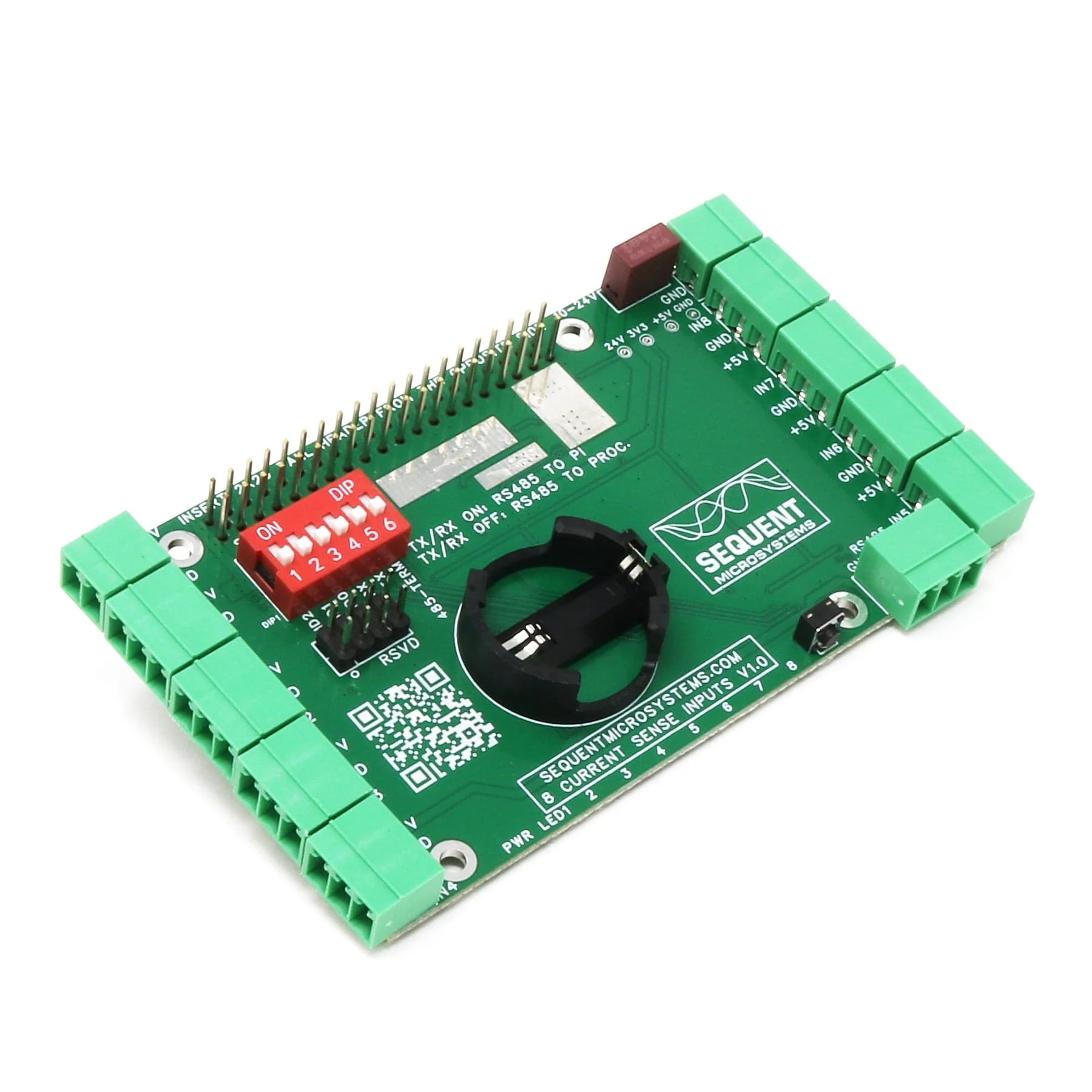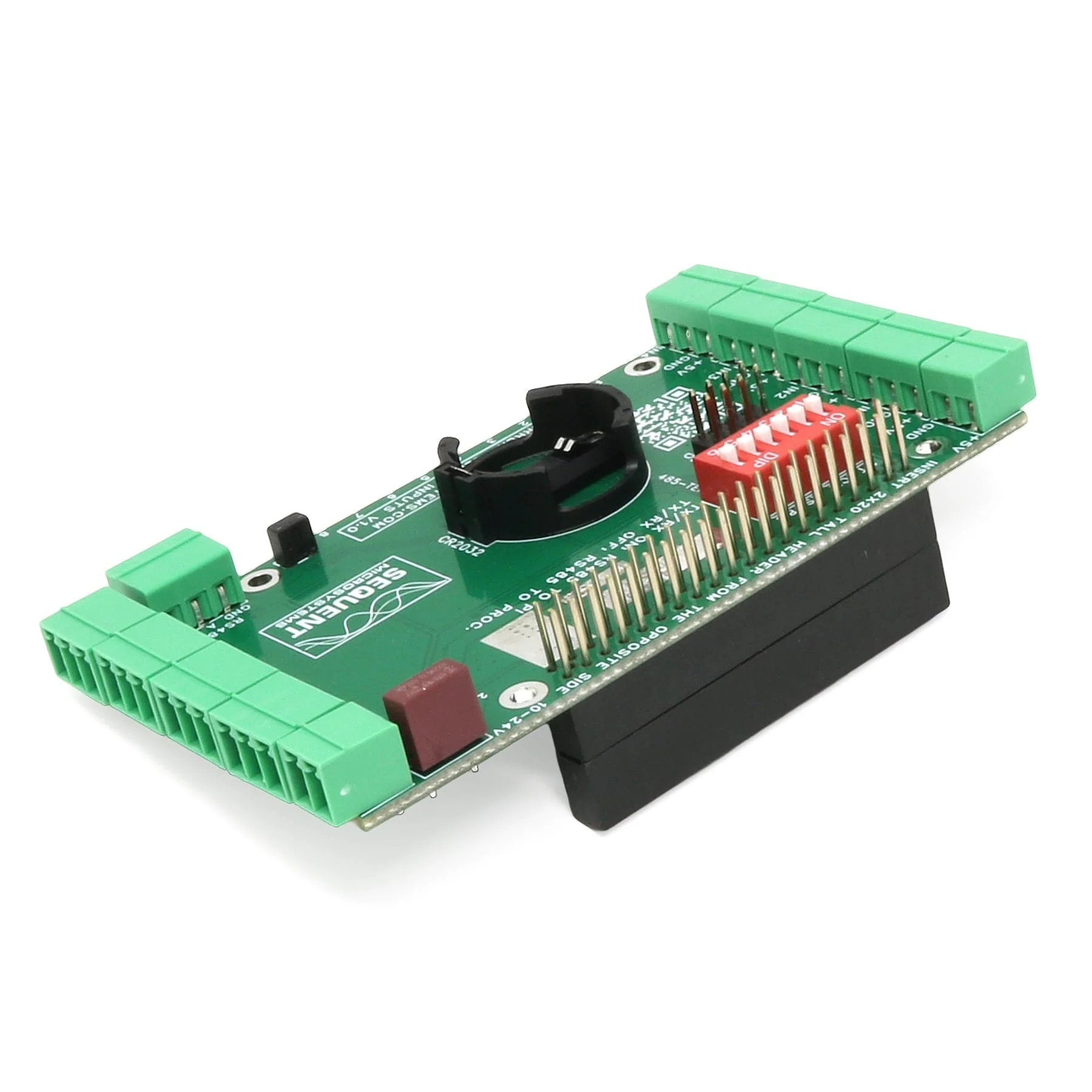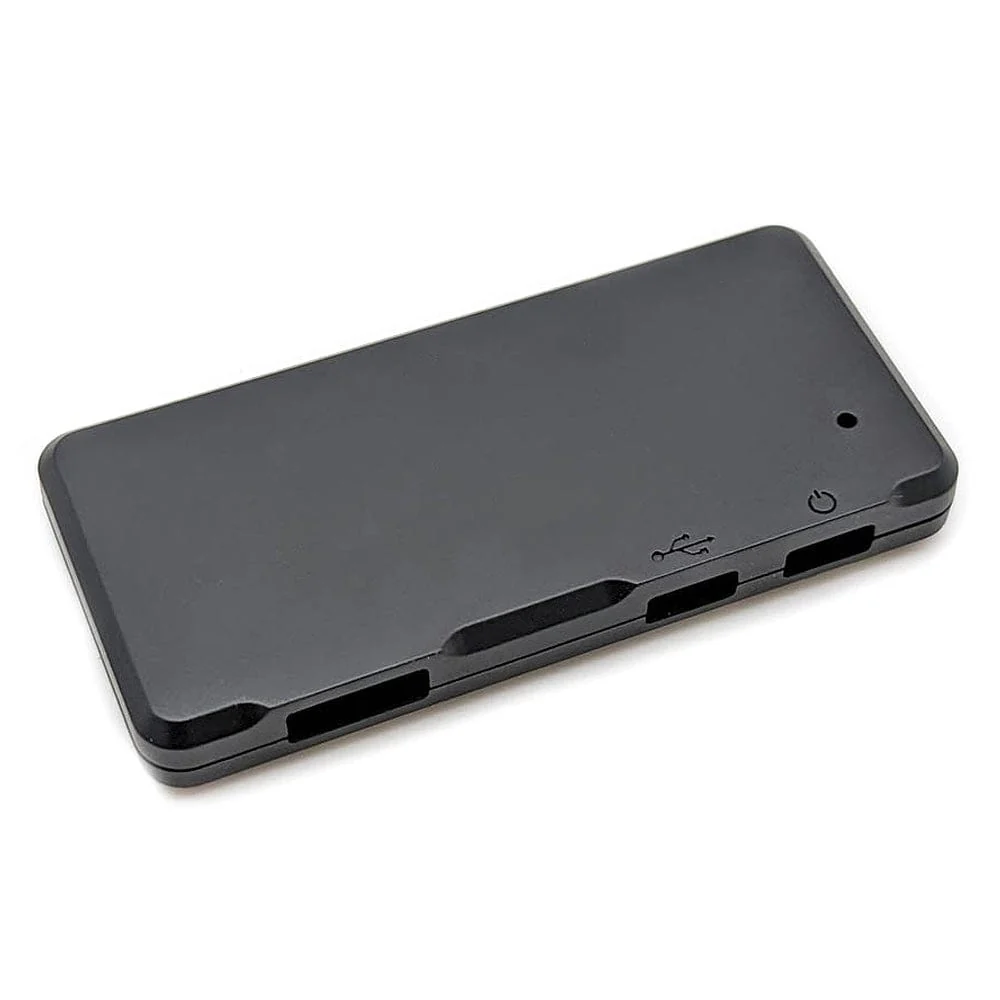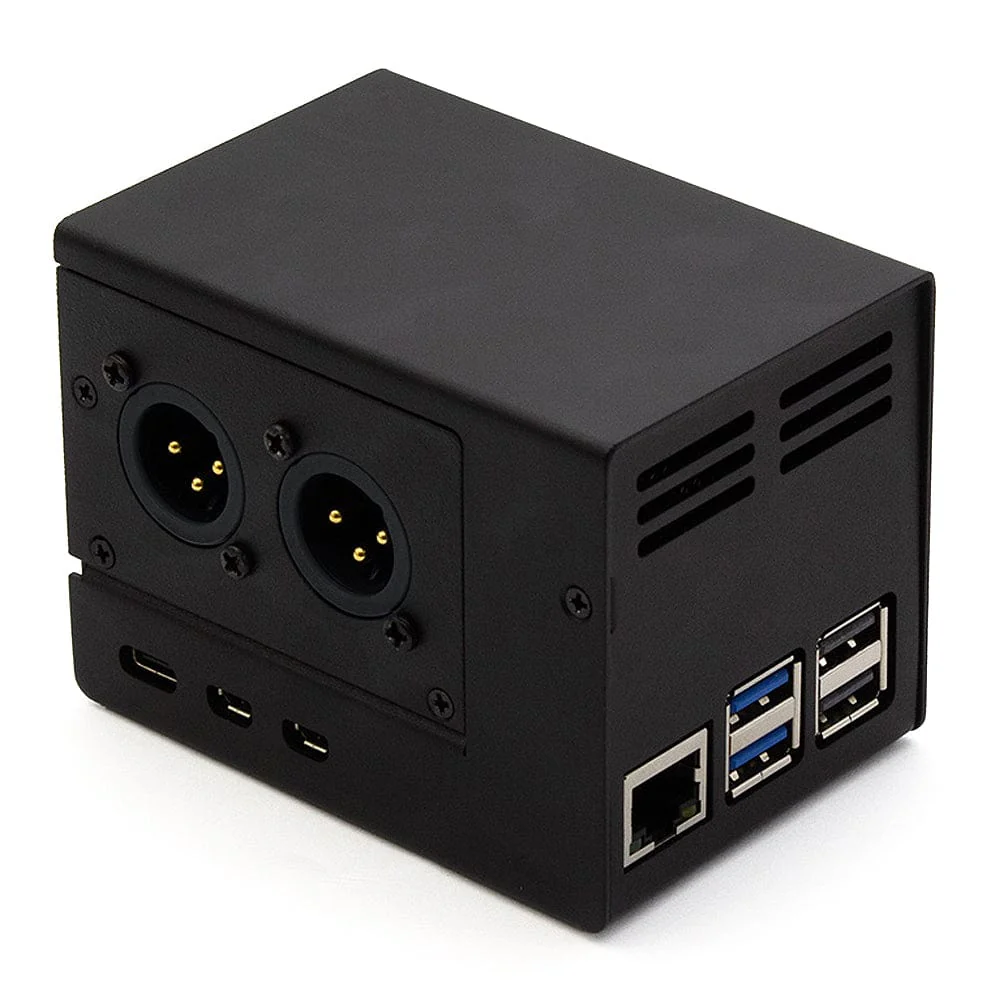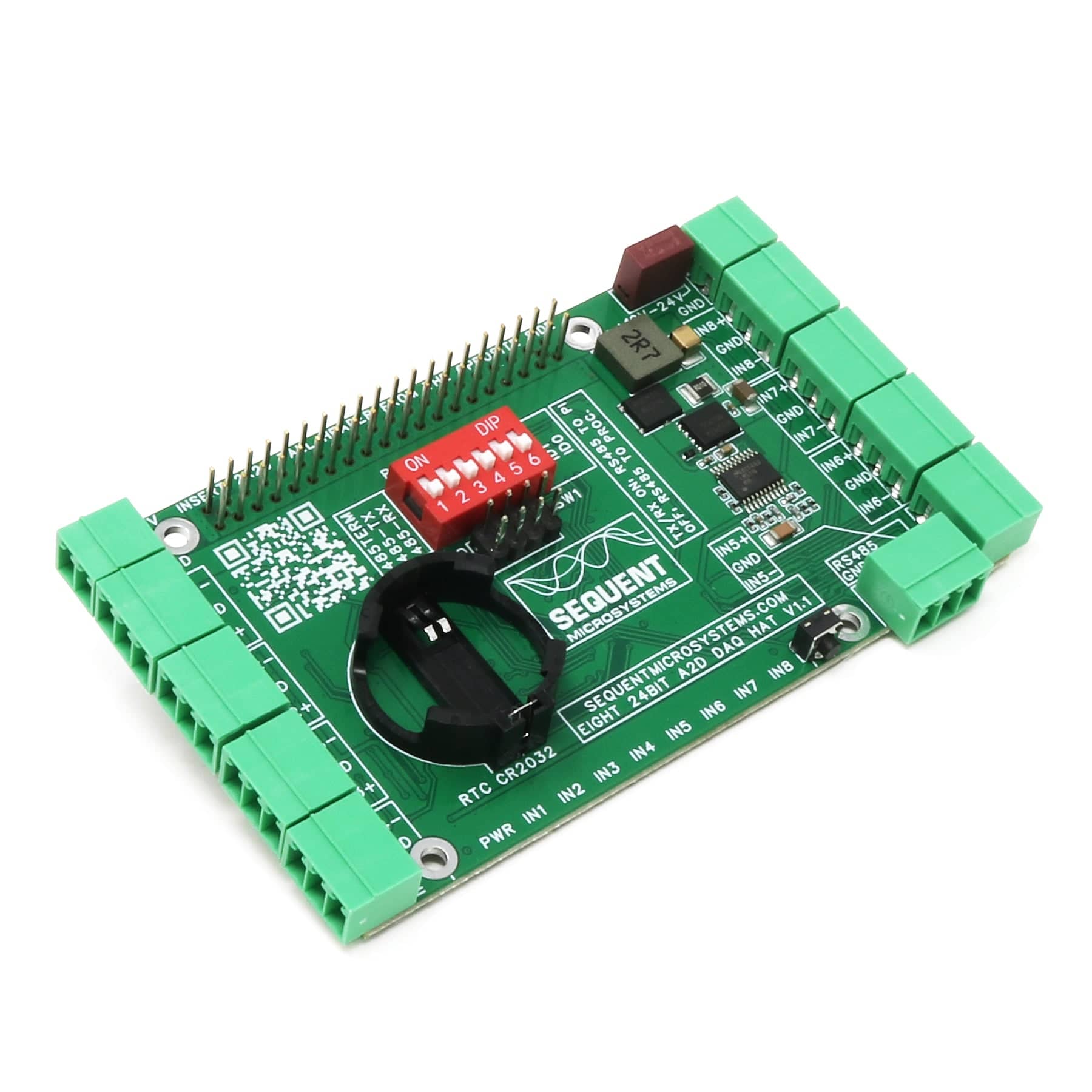
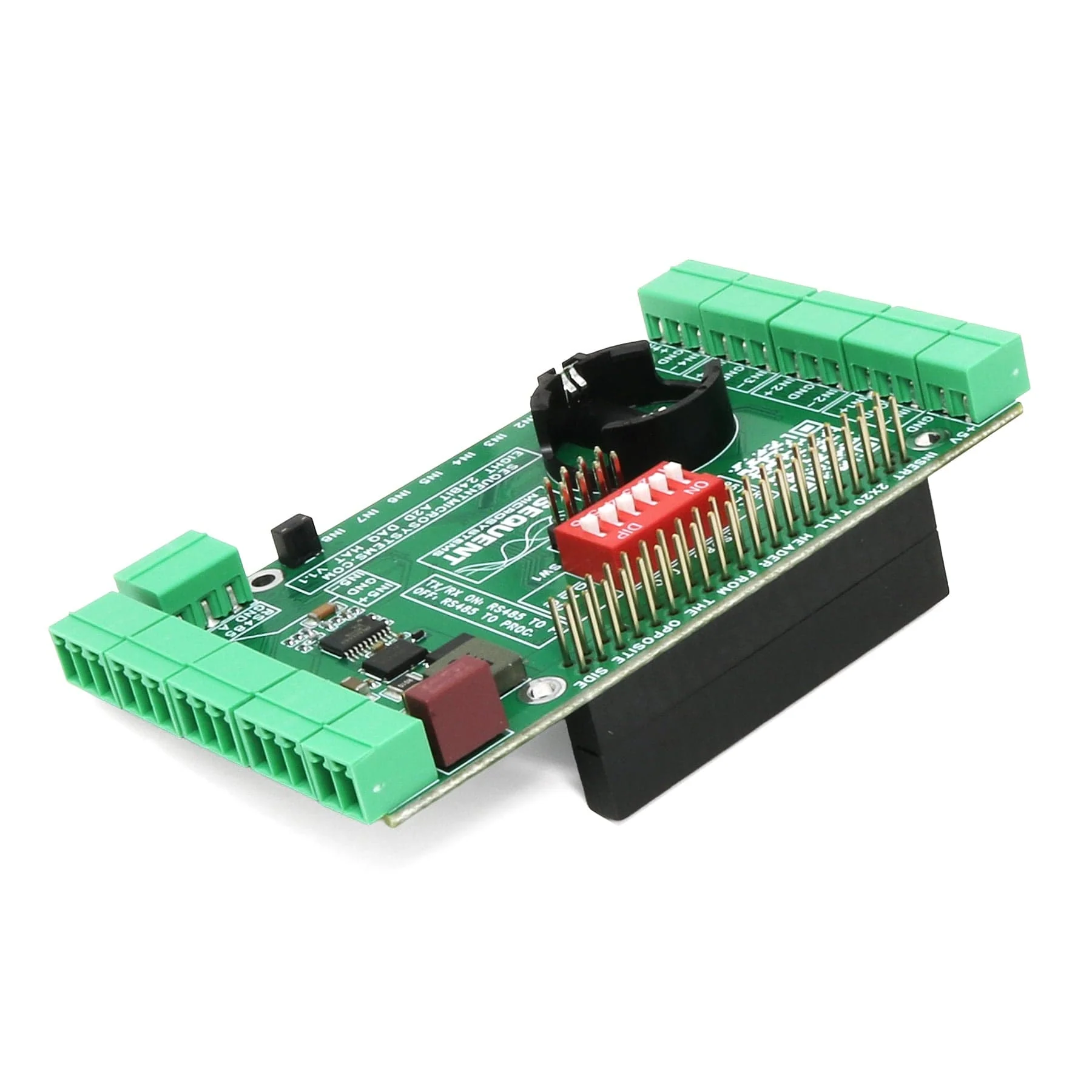
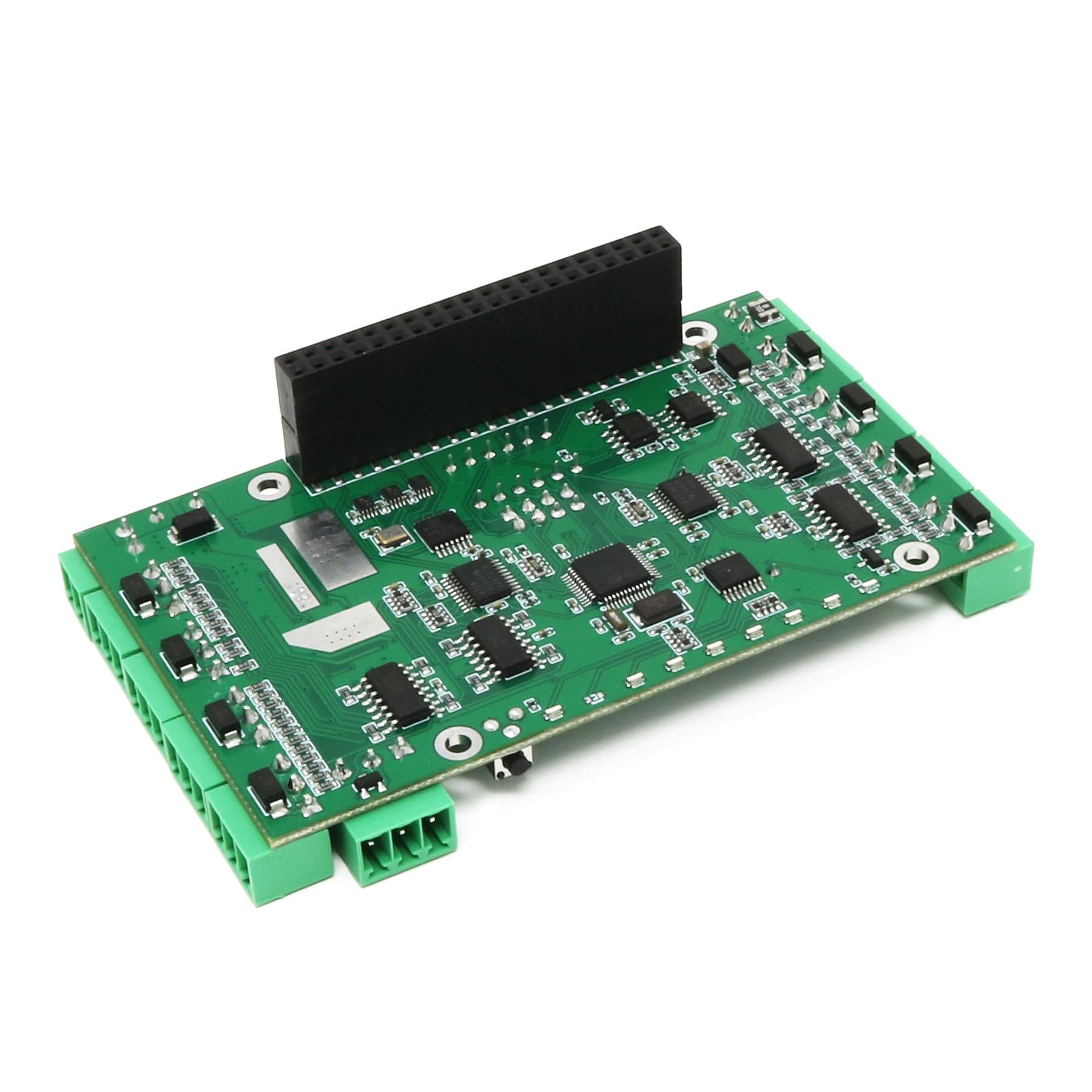
Eight 24-Bit Analog Inputs DAQ HAT for Raspberry Pi V1.1
Eight Differential or Common Ground 24 bit inputs for Raspberry Pi, software selectable to ±0.75V, ±1.5V, ±3V, ±6V, ±12V or ±24V, with status LEDs, RS485 and watchdog.
The Raspberry Pi has no analog signal processing capability. This HAT can read eight differential or common ground analog signals with 24 bit precision and up to 64kBPS data rate.
Stackable to 8 levels, the card works with all Raspberry Pi versions, from Pi Zero to Raspberry Pi 5. Up to eight cards can be stacked on top of one Raspberry Pi. When multiple cards are stacked, the master card can send the clock and sync signal to all slave cards, allowing synchronized data acquisition over all the channels.
It also has an RS-485 port, a power LED and a push button that can be used to shut down the Raspberry Pi. Pluggable connectors make the card easy to use when multiple cards are stacked up.
Two of the Raspberry Pi’s GPIO pins are used for I2C communication. Another pin is allocated for the interrupt handler, leaving 23 GPIO pins available for the user. The RS485/MODBUS port permits almost unlimited expandability. On board Real Time Clock with CR2032 battery backup (battery not included) keeps the time almost indefinitely in case of power failure. And last but not least, a hardware watchdog can power cycle the Raspberry Pi in case of software lockup.
TVS diodes on all inputs protect the card for external ESD. An onboard resettable fuse protects it from accidental shorts. The card can be powered from a 5V/5A or from 12V-24VDC power supply. In both cases, it provides up to 4A continuous and 5A peak to the Raspberry Pi.
Raspberry Pi not included
Compatibility
Compatible with all Raspberry Pi versions from Zero to 5.
Power Requirements
The HAT needs 5V to operate and can be powered from its own 2 pin pluggable connector. The card draws 50mA. If power is applied to the 2 pin pluggable connector, no other power supply is needed for the Raspberry Pi.
LED Indicators
A power LED shows when power is applied to the board. Eight LEDs shows the status of groups of 8 inputs. Inputs 1-8 or 9-16 can be selected from software.
DIP Switch Configuration
A six position DIP switch is used to select the source of the RS485 port and the position of the card in the stack, if multiple cards are used. The left-most position is the RS485 terminator. Set this switch ON if the card is the last one on the RS485 chain. The next two positions select the source of the RS485 port. Set the switches ON to drive the RS485 from the Raspberry Pi, or OFF to drive the port from the local processor.
Reset Button
Shutting down the Raspberry Pi by turning off the power can result in SD Card failure. To prevent this, a shutdown command needs to be used before power cut-off. But this requires a monitor, keyboard, and mouse connected to the Pi.
A momentary on push button installed at the edge of the card provides a convenient way to shut down the Raspberry Pi. The button is routed to pin 37 (GPIO 26). You need to write a script which monitors this pin, and if pressed for more than a desired time, issues the shut-down command.
DIN Rail Mounting
The card can be installed parallel on a DIN-Rail using the DIN-Rail Kit Type 1, or perpendicular using the DIN-Rail Kit Type 2.
Features
- Eight 24-Bit Analog Inputs DAQ 8-Layer Stackable HAT
- All inputs differential with or without common ground
- Eight layer stackable to 64 differential analog inputs
- Software selectable inputs: ±0.18V, ±0.37V, ±0.75V, ±1.5V, ±3V, ±6V, ±12V, ±24V
- Wide range power supply: 5V or 12V-24V
- Provides 4A continuous, 5A peak power to Raspberry Pi
- RS485/MODBUS port
- Uses two ADS131 24-bit Delta-Sigma ADCs from Texas Instruments
- Input impedance 300KΩ to 1MΩ
- Data rates up to 64 kSPS
- Internal or external, software selectable clock and trigger
- Hardware watchdog can power cycle the Raspberry Pi
- Real Time Clock with CR2032 battery backup
- Uses only I2C port, all GPIO pins available
- Eight LEDs with programmable threshold for input status
- Pluggable Connectors 26-16 AWG wires
- General purpose push-button
- Works with any Raspberry Pi from ZERO to 5
- ECCN Code EAR99
- Command Line Driver
- Python Library
- Node-Red nodes
- OpenPLC module
- CODESYS Library
- MODBUS Interface
Electrical Specifications
- Power Supply: 5V/8A pluggable connector
- On board resettable fuse: 4A
- Maximum input signal: 3.3V
- Programmable gain: 1 to 128
- Minimum input signal: 25mV full scale
- Maximum data rate: 64.4 kSPS at 80 dB dynamic range
- Minimum input impedance 1MΩ for gain > 8
- Power consumption max. 50mA
Resources
- Hardware Schematics V1.1
- 3D Printing Enclosure
- 3D STEP Model V1.1
- Command Line
- Python Libraries
- MODBUS Interface
Package Contents
- 1x Eight 24-Bit Analog Inputs DAQ HAT for Raspberry Pi V1.1
- 1x Mounting hardware pack
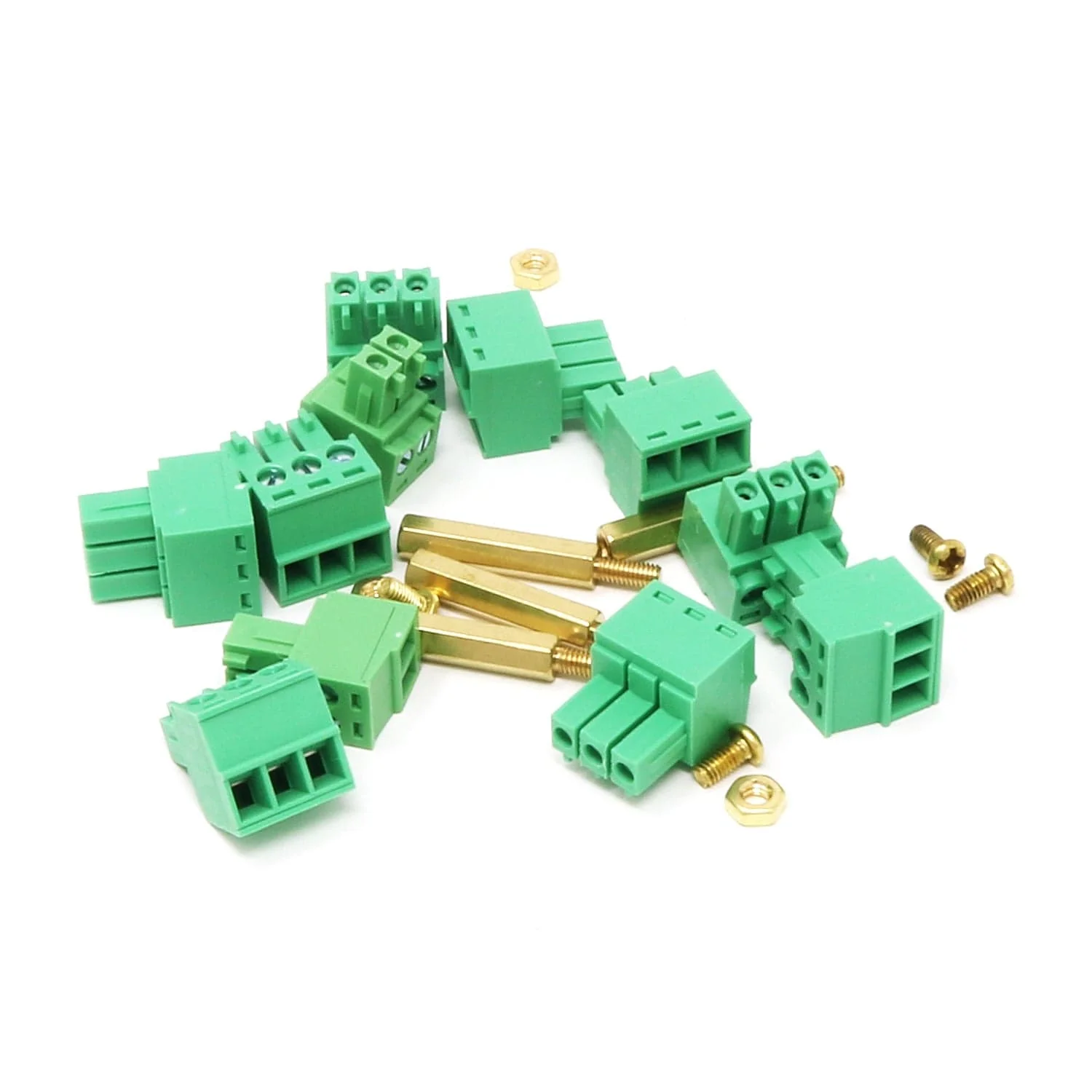
- 1x Mating connector plug pack
Raspberry Pi not included
Original: $139.20
-65%$139.20
$48.72Product Information
Product Information
Shipping & Returns
Shipping & Returns
Description
Eight Differential or Common Ground 24 bit inputs for Raspberry Pi, software selectable to ±0.75V, ±1.5V, ±3V, ±6V, ±12V or ±24V, with status LEDs, RS485 and watchdog.
The Raspberry Pi has no analog signal processing capability. This HAT can read eight differential or common ground analog signals with 24 bit precision and up to 64kBPS data rate.
Stackable to 8 levels, the card works with all Raspberry Pi versions, from Pi Zero to Raspberry Pi 5. Up to eight cards can be stacked on top of one Raspberry Pi. When multiple cards are stacked, the master card can send the clock and sync signal to all slave cards, allowing synchronized data acquisition over all the channels.
It also has an RS-485 port, a power LED and a push button that can be used to shut down the Raspberry Pi. Pluggable connectors make the card easy to use when multiple cards are stacked up.
Two of the Raspberry Pi’s GPIO pins are used for I2C communication. Another pin is allocated for the interrupt handler, leaving 23 GPIO pins available for the user. The RS485/MODBUS port permits almost unlimited expandability. On board Real Time Clock with CR2032 battery backup (battery not included) keeps the time almost indefinitely in case of power failure. And last but not least, a hardware watchdog can power cycle the Raspberry Pi in case of software lockup.
TVS diodes on all inputs protect the card for external ESD. An onboard resettable fuse protects it from accidental shorts. The card can be powered from a 5V/5A or from 12V-24VDC power supply. In both cases, it provides up to 4A continuous and 5A peak to the Raspberry Pi.
Raspberry Pi not included
Compatibility
Compatible with all Raspberry Pi versions from Zero to 5.
Power Requirements
The HAT needs 5V to operate and can be powered from its own 2 pin pluggable connector. The card draws 50mA. If power is applied to the 2 pin pluggable connector, no other power supply is needed for the Raspberry Pi.
LED Indicators
A power LED shows when power is applied to the board. Eight LEDs shows the status of groups of 8 inputs. Inputs 1-8 or 9-16 can be selected from software.
DIP Switch Configuration
A six position DIP switch is used to select the source of the RS485 port and the position of the card in the stack, if multiple cards are used. The left-most position is the RS485 terminator. Set this switch ON if the card is the last one on the RS485 chain. The next two positions select the source of the RS485 port. Set the switches ON to drive the RS485 from the Raspberry Pi, or OFF to drive the port from the local processor.
Reset Button
Shutting down the Raspberry Pi by turning off the power can result in SD Card failure. To prevent this, a shutdown command needs to be used before power cut-off. But this requires a monitor, keyboard, and mouse connected to the Pi.
A momentary on push button installed at the edge of the card provides a convenient way to shut down the Raspberry Pi. The button is routed to pin 37 (GPIO 26). You need to write a script which monitors this pin, and if pressed for more than a desired time, issues the shut-down command.
DIN Rail Mounting
The card can be installed parallel on a DIN-Rail using the DIN-Rail Kit Type 1, or perpendicular using the DIN-Rail Kit Type 2.
Features
- Eight 24-Bit Analog Inputs DAQ 8-Layer Stackable HAT
- All inputs differential with or without common ground
- Eight layer stackable to 64 differential analog inputs
- Software selectable inputs: ±0.18V, ±0.37V, ±0.75V, ±1.5V, ±3V, ±6V, ±12V, ±24V
- Wide range power supply: 5V or 12V-24V
- Provides 4A continuous, 5A peak power to Raspberry Pi
- RS485/MODBUS port
- Uses two ADS131 24-bit Delta-Sigma ADCs from Texas Instruments
- Input impedance 300KΩ to 1MΩ
- Data rates up to 64 kSPS
- Internal or external, software selectable clock and trigger
- Hardware watchdog can power cycle the Raspberry Pi
- Real Time Clock with CR2032 battery backup
- Uses only I2C port, all GPIO pins available
- Eight LEDs with programmable threshold for input status
- Pluggable Connectors 26-16 AWG wires
- General purpose push-button
- Works with any Raspberry Pi from ZERO to 5
- ECCN Code EAR99
- Command Line Driver
- Python Library
- Node-Red nodes
- OpenPLC module
- CODESYS Library
- MODBUS Interface
Electrical Specifications
- Power Supply: 5V/8A pluggable connector
- On board resettable fuse: 4A
- Maximum input signal: 3.3V
- Programmable gain: 1 to 128
- Minimum input signal: 25mV full scale
- Maximum data rate: 64.4 kSPS at 80 dB dynamic range
- Minimum input impedance 1MΩ for gain > 8
- Power consumption max. 50mA
Resources
- Hardware Schematics V1.1
- 3D Printing Enclosure
- 3D STEP Model V1.1
- Command Line
- Python Libraries
- MODBUS Interface
Package Contents
- 1x Eight 24-Bit Analog Inputs DAQ HAT for Raspberry Pi V1.1
- 1x Mounting hardware pack
- 1x Mating connector plug pack
Raspberry Pi not included